

The Language of the Future in Engineering and Medicine: Why Do German Hospitals and Companies Require Strong German Skills?
Published on 2026-10-01 · By Rajab Elnaghi
When an Arab doctor or engineer decides to pursue a career in Germany, a common question often comes to mind: “If medical terminology is universal, and programming and engineering are largely based on English, why is there such a strong emphasis on mastering German?”
The answer lies in the nature of the responsibility associated with these two professions. In Germany, professional competence is not measured by technical knowledge alone, but also by the ability to communicate and apply that knowledge accurately, with as little room for misunderstanding as possible.
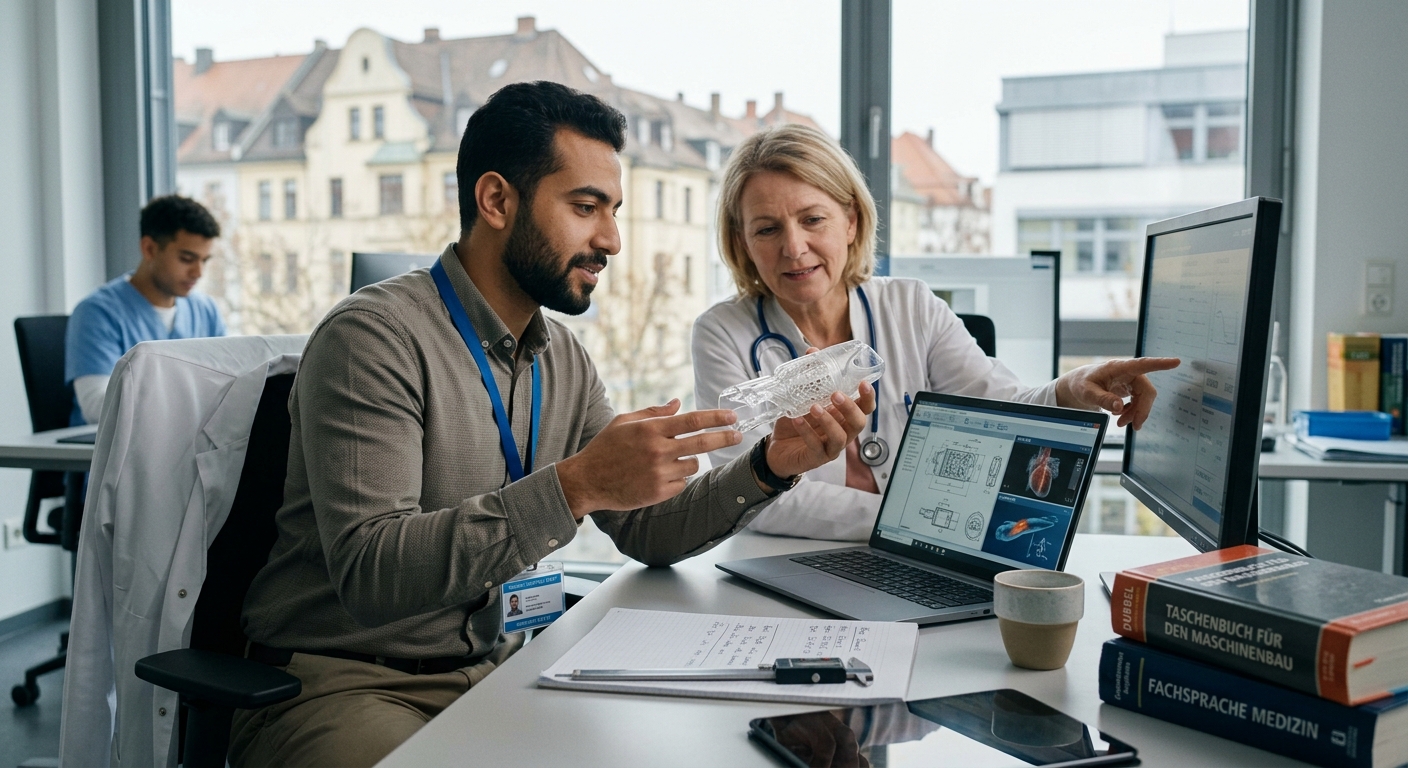
Imagine a doctor working in an emergency department in Munich or Berlin. An elderly patient may describe an unclear chest pain in a local accent, or a frightened child may have only a few simple words to describe what they are experiencing. In such situations, English and Latin terminology are of limited value if the doctor cannot understand the precise details of the symptoms, reassure the patient, and explain the treatment plan in clear and compassionate language. Human communication is an essential part of healthcare, and linguistic misunderstandings in this field can have serious consequences. This is one of the reasons why medical professionals seeking to practice in Germany may be required to demonstrate advanced professional language skills, including passing the Fachsprachenprüfung where applicable.
The situation in engineering is no less demanding. While major projects in fields such as software and automotive engineering often rely on international teams, German remains an important working language in many factories, construction sites, and technical environments. Engineers need to understand technical documentation and safety instructions, communicate with technicians, coordinate with suppliers, and prepare professional safety reports.
A successful engineer is not simply someone who works behind a screen. They may also need to communicate directly with production teams, participate in meetings, coordinate projects, and discuss complex technical and contractual matters. Strong German skills can therefore help an engineer move beyond simply performing technical tasks and take on greater responsibility within a team.
German hospitals and companies do not necessarily view language requirements as an obstacle; rather, language proficiency is an important part of professional communication, workplace integration, patient safety, and quality standards.
Mastering German is more than learning a new language. It is an investment in your professional future—one that enables you to use your qualifications and expertise effectively in the German workplace.