
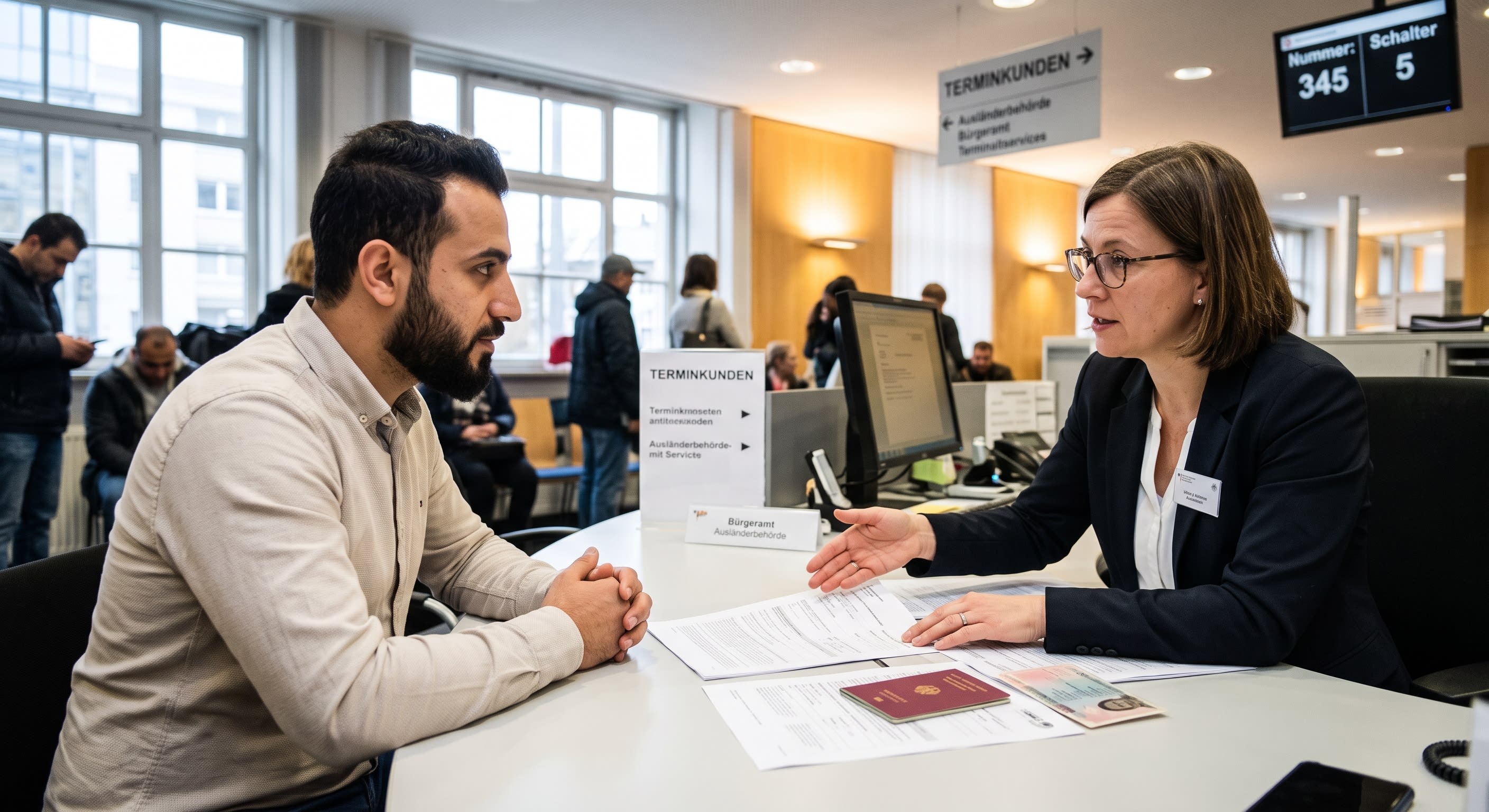
The Language of Official Procedures in Germany: Key Terms for Dealing with the Foreigners’ Authority and Bürgeramt
Published on 2026-10-04 · By Rajab Elnaghi
When dealing with government institutions in Germany, knowledge of everyday German is not always enough. Official correspondence and forms use a formal administrative language containing terms that may seem familiar but have a more precise administrative or legal meaning.
This is particularly evident when dealing with the Foreigners’ Authority (Ausländerbehörde) or the Bürgeramt, the local citizens’ office responsible for a range of administrative services. Understanding these terms helps residents know what is being requested, what their rights and obligations are, and at what stage their application currently stands.
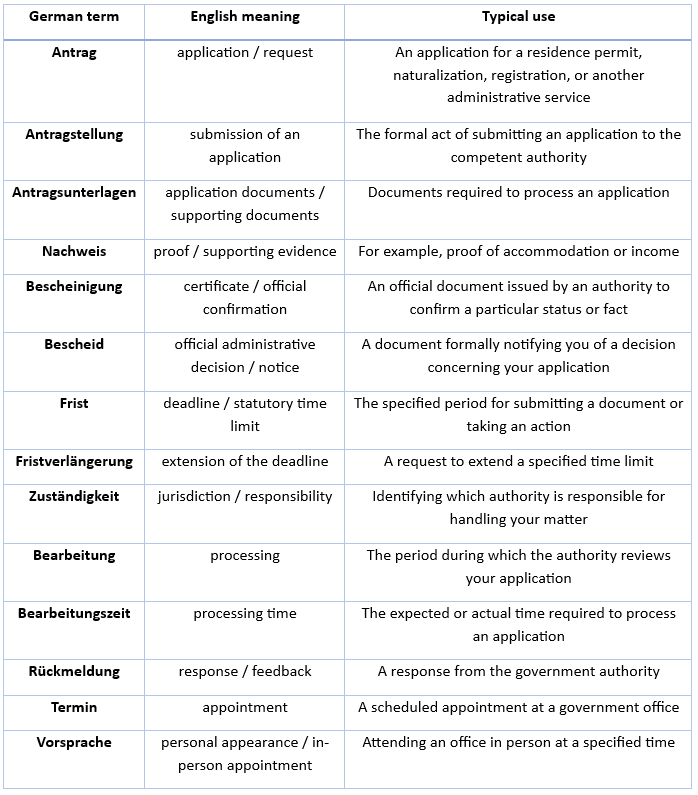
First: Essential Terms Used in Official Procedures
Second: Important Terms Used by the Ausländerbehörde
When dealing with the Ausländerbehörde, you will encounter a range of terms directly related to your residence status.
Aufenthaltstitel is the general term for a residence title or residence permit. It is one of the most important terms to understand and should be distinguished from the various specific types of residence status.
Aufenthaltserlaubnis refers to a temporary residence permit, generally granted for a specific purpose, such as employment, study, or family reunification.
Other important terms include:
Aufenthaltsrecht — right of residence.
Aufenthaltsstatus — residence status.
Verlängerung — extension / renewal.
Erteilung — granting / issuance of a permit or document.
Niederlassungserlaubnis — permanent settlement permit / permanent residence permit.
Fiktionsbescheinigung — a temporary certificate confirming the legal status of residence while a decision on an application is pending, where the relevant legal requirements are met.
Ausreisepflicht — obligation to leave Germany.
Duldung — temporary suspension of deportation in cases provided for by law. It is not, in itself, a residence permit in the usual sense.
This is where linguistic precision becomes particularly important. For example, translating Duldung simply as “temporary residence” can lead to a misunderstanding of the holder’s legal status, because the term has a specific legal meaning.
Third: Terms You May Encounter in Letters from the Ausländerbehörde
If you receive a letter containing the sentence:
„Bitte reichen Sie die fehlenden Unterlagen nach.“
the meaning is not simply “Please send the documents.” Rather, the authority is informing you that documents are missing and asking you to complete the application file.
Likewise:
„Ihr Antrag befindet sich noch in Bearbeitung.“
means that your application is still being processed. It does not necessarily mean that the application has been approved.
Another common expression is:
„Wir bitten um Geduld.“
This means that the authority is asking you to wait. It does not, by itself, constitute a commitment to complete the procedure by a specific date.
One of the most important expressions is:
„Bitte beachten Sie die Frist.“
This means: “Please observe the deadline.”
Here, it is important to distinguish between Frist and Termin. A Termin is an appointment, such as an appointment to appear at an office, whereas a Frist is a period within which a specific action must be taken.
Fourth: Terms Used by the Bürgeramt
At the Bürgeramt, residents encounter a somewhat different set of procedures, particularly those relating to residential registration and personal documents.
Important terms include:
Anmeldung — registration of residence.
Ummeldung — registration of a change of address.
Abmeldung — deregistration, for example when leaving Germany in cases where deregistration is required.
Meldebescheinigung — certificate of residence registration.
Wohnsitz — residence / place of residence.
Hauptwohnsitz — main residence.
Nebenwohnsitz — secondary residence.
Wohnungsgeberbestätigung — confirmation from the landlord or housing provider used for residence registration procedures.
Personalausweis — German identity card.
Reisepass — passport.
A common mistake is to translate Anmeldung simply as “registration.” In the German administrative context, it generally refers to registering your residential address with the competent authority, rather than to registration in a general sense.
Fifth: How to Understand the Language of Government Letters
German government correspondence tends to use an indirect and formal style. Instead of saying:
„Sie müssen dieses Dokument schicken.“
the authority may write:
„Bitte reichen Sie das Dokument innerhalb der genannten Frist ein.“
meaning: “Please submit the document within the stated deadline.”
Administrative correspondence may also use expressions such as:
„Es wird darauf hingewiesen, dass …“
meaning: “It is pointed out that …” or “Please note that …”
Another common formulation is:
„Sollten Sie Fragen haben, wenden Sie sich bitte an …“
meaning: “If you have any questions, please contact …”
These formulations are not merely stylistic. They are part of administrative and institutional language (Verwaltungssprache) and can therefore appear more complex than the German used in everyday communication.
Conclusion
Dealing with the Ausländerbehörde or Bürgeramt requires more than simply knowing German vocabulary. It requires an understanding of the administrative context in which these terms are used.
The distinction between Antrag and Bescheid, Termin and Frist, or Aufenthaltstitel and Duldung can be highly important when it comes to understanding the status of an application and the obligations associated with it.
For this reason, the best way to deal with official correspondence is not to translate individual words in isolation, but to read each term within the complete sentence, document, and procedural context.